As we continue to celebrate the 40th anniversary of York Health Economics Consortium (YHEC), our blog series turns its focus toward the future of healthcare delivery. For four decades, we have worked alongside health systems, advising, evaluating and modelling change through commissioned and independent research to help navigate transformation.
A central pillar of the NHS 10-Year Health Plan for England (published July 2025) is the concept of “neighbourhood health”, an ambition to move care out of hospitals and back into our communities. While the terminology might be new, the underlying direction is not. Previous strategies, particularly the NHS Long Term Plan (2019), set out similar ambitions around community-based care, prevention, and integration. What feels different now is the expectation that this shift is delivered at scale, within a more defined local system architecture.
In this blog, Director of NHS Consulting, Nick Hex, and Research Consultant, Hannah Ross, explore whether this “neighbourhood” model can truly shift the dial on productivity and health inequalities, or if it remains an elusive panacea. They dig into the economic realities of this transition and ask a vital question: how do we ensure this new model delivers real value for money?
What is neighbourhood health?
Neighbourhood health is one of the core initiatives described in the NHS 10-Year Health Plan. The concept is somewhat complex to define but its central aim is to help shift the balance of care from hospitals to community settings. This is one of the key pillars of the Plan, along with moving from analogue to digital, and moving away from reactive care towards prevention. Implemented effectively, neighbourhood health should also impact positively on the other two pillars: out-of-hospital care often requires technology-enablement; and anticipatory care and prevention strategies are used to avoid hospital admissions.
The Government describes neighbourhood health as ‘a radical shift in how we approach health and care, centred around neighbourhood working’. Its ‘community of practice’ has been established to share what works, solve problems collectively, build relationships and help to inform national policy. According to the King’s Fund [1], core components of neighbourhood health include integration, prevention, personalised care, care delivered closer to home, community-led approaches to care and place-based care.
Despite being described as a ‘radical shift’, none of these components are new. The foundations of the NHS are based on the provision of care close to people’s homes, with hospital as a last resort. For many years, people have talked about concepts such as integration and prevention being the panacea for the pressures the NHS faces. So why do we need these concepts to be rebadged under this ambitious programme?
Shifting the dial
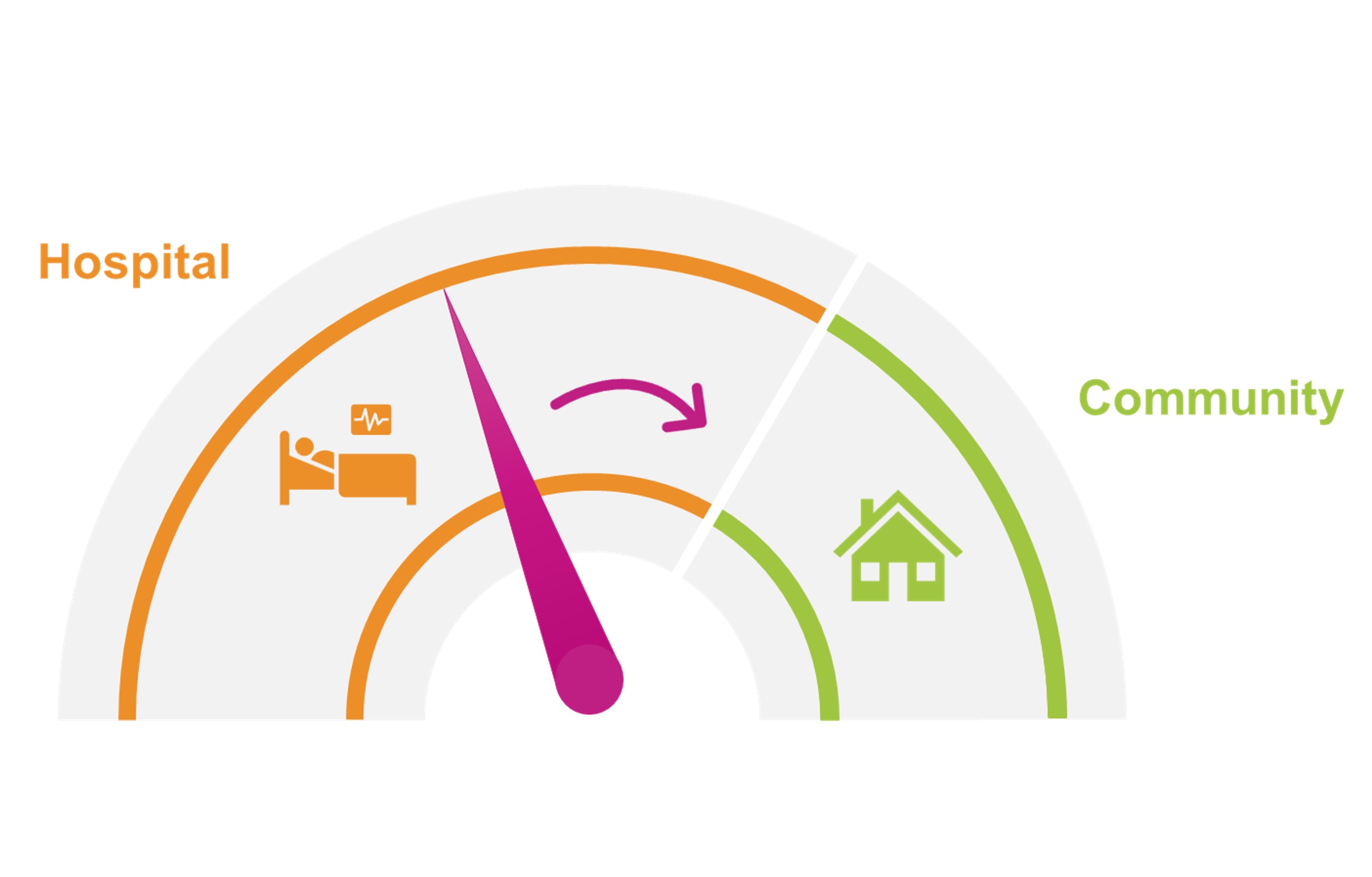
The concept of shifting the balance of care has been an ambition for successive governments but very little has changed over the years. If anything, the balance has gone in the opposite direction: from 2014 to 2021, NHS spending on community health services reduced from 9% to 7%, spending on primary care reduced from 21% to 18%, while spending on hospitals rose from 54% to 58% [2].
Neighbourhood health is, therefore, an attempt to make good on previous ambitions and turn this into a reality. This will require a shift in funding from hospital care to community care. This will be challenging given that the government is also still having to address issues such as reducing hospital waiting lists, which implies a need for increased secondary care funding.
Productivity is clearly an important consideration in shifting the balance of care. The Institute of Government [3] has observed that increasing hospital staff is not converting to a proportional increase in completed elective cases, and in some Integrated Care Boards (ICBs), productivity is actually decreasing. The NHS Confederation found that areas that spend less on community care in terms of population need have seen higher-than-average levels of hospital and emergency activity [4]. This would imply that targeting community care and prevention activity may help reduce pressure on hospital services, complementing efforts to tackle waiting lists.
Integrating care
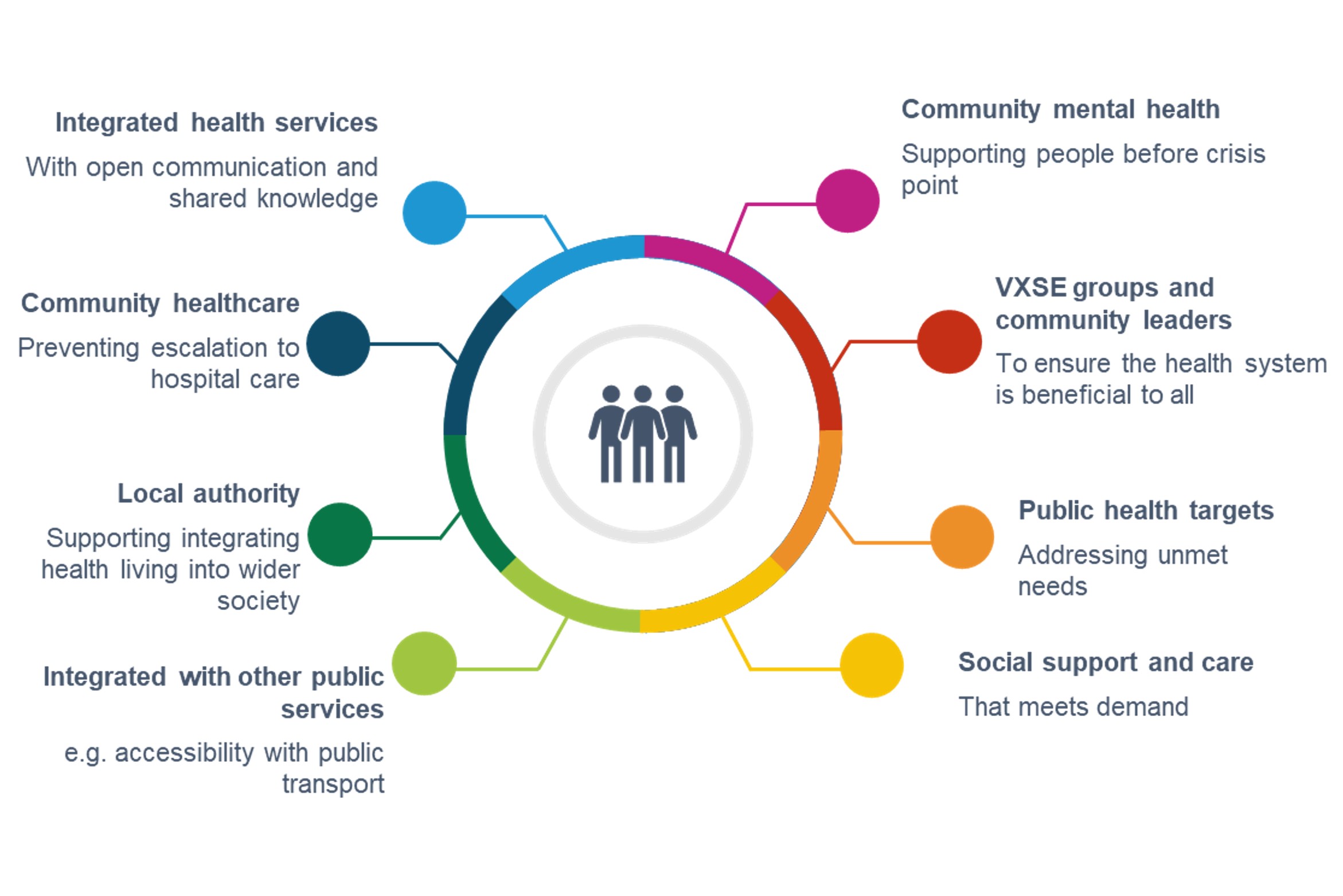
As well as funding, implementing a neighbourhood health model requires integration and communication between sectors. There is often a disconnect between health care and social care, as well as within the healthcare system itself. For example, pharmacy services tend to be less integrated with the healthcare system. This is often driven by a lack of access to shared electronic health records and a lack of effective communication channels.
Implementing an integrated neighbourhood model requires productive relationships with community leaders, involving them in the co-design and co-delivery of services to ensure models are adapted to a unique context rather than a one-size-fits-all model, which can result in gaps in care. One of the biggest potential benefits of neighbourhood health closer to home is that it could help to address inequalities by improving access to healthcare. To achieve this, it will be important to focus on working with community leaders who represent underserved groups and to involve them in the design process to reduce the chances of creating gaps in the service. Integration needs to be at the forefront of developing neighbourhood health models to implement the intended radical shift.
Social care has a vital role to play in the integration of care but it faces arguably even bigger challenges than NHS care. Spending on social care is increasing, but despite this, the proportion of councils expected to overspend their adult social care budgets is expected to have increased to 81% for the 2024/25 financial year [5]. There are many cost pressures in social care, including above-inflation increases in care home and home care fees driven by the increase in the statutory minimum wage. Despite that, in general, social care pay has failed to keep up with other sectors, so that people can earn the same amount working as retail assistants and can earn more in similar roles in the NHS [6]. Support for unpaid carers has decreased over time and informal care is a vital cog in the provision of health and care support for people in the community.
Will neighbourhood health represent value for money?
The 10-year plan places an emphasis on strategic commissioning so an important issue will be whether neighbourhood health is cost effective. Drugs and most medical devices are regulated and require approval by the National Institute for Health and Care Excellence (NICE). ICBs have to decide how care is provided and the balance between acute treatment and concepts, such as diagnosis and prevention. Health and social care decision makers should adopt a similar mindset to NICE when considering how care is to be configured. This means developing business cases to show the impact any changes in care provision will have on costs and, importantly, whether the health of the population will be improved. This could be enabling people to live longer or improving their quality of life through, for example, helping them to avoid disease.
The King’s Fund’s view is that, although often framed as cost saving, measures to shift care into the community are unlikely to save costs or resources in the short term. However, the move to strategic commissioning may mean that more ICBs are willing to allow innovations that incur costs but lead to better longer-term outcomes and reduced future healthcare resources.
YHEC’s recent experience of working with ICBs to evaluate virtual wards (or hospital at home) suggested that the ICB imperative was to ensure that any changes to care pathways should be cost saving within the financial year [7]. The Government will need to reassure ICBs that they have permission to invest in longer-term strategies and, crucially, it will need to ensure that reimbursement mechanisms can help to make this a reality. Health prevention strategies will require political will, both centrally and locally, to become a reality. Alongside that, health and social care stakeholders will need to transition their thinking toward a strategic commissioning mindset.
This is all very ambitious, but a focus on cost-effective forms of health and social care integration can deliver neighbourhood health that can shift the balance of care and improve the health of local populations.
Contact us
YHEC is already supporting ICBs and health systems, as well as innovators and industry partners, to evaluate the impact and demonstrate the value of neighbourhood health models and community-based innovations. If this is something you are developing or seeking to evidence, please contact Director of NHS Consulting, Nick Hex, at [email protected].
References
- The King’s Fund. What is neighbourhood health. 2026. Available from: https://www.cochrane.org/about-us/news/celebrating-archie-cochrane
- GOV.UK. Independent investigation of the NHS in England. 2024. Available from: https://www.gov.uk/government/publications/independent-investigation-of-the-nhs-in-england
- Institute for Government. Performance Tracker 2025: Hospitals. 2025. Available from: https://www.instituteforgovernment.org.uk/publication/performance-tracker-2025/nhs/hospitals
- NHS Confederation. Unlocking the power of health beyond the hospital. 2023. Available from: https://www.nhsconfed.org/publications/unlocking-power-health-beyond-hospital
- The King’s Fund. Social care 360: expenditure. 2026. Available from: https://www.kingsfund.org.uk/insight-and-analysis/long-reads/social-care-360-expenditure
- The King’s Fund. Social care 360: workforce and carers. 2026. Available from: https://www.kingsfund.org.uk/insight-and-analysis/long-reads/social-care-360-workforce-carers
- Health Innovation Network. Virtual wards economic cost model. Available from: https://healthinnovationnetwork.com/resources/virtual-wards-economic-cost-model/