World Orphan Drug Congress (WODC) Europe 2026
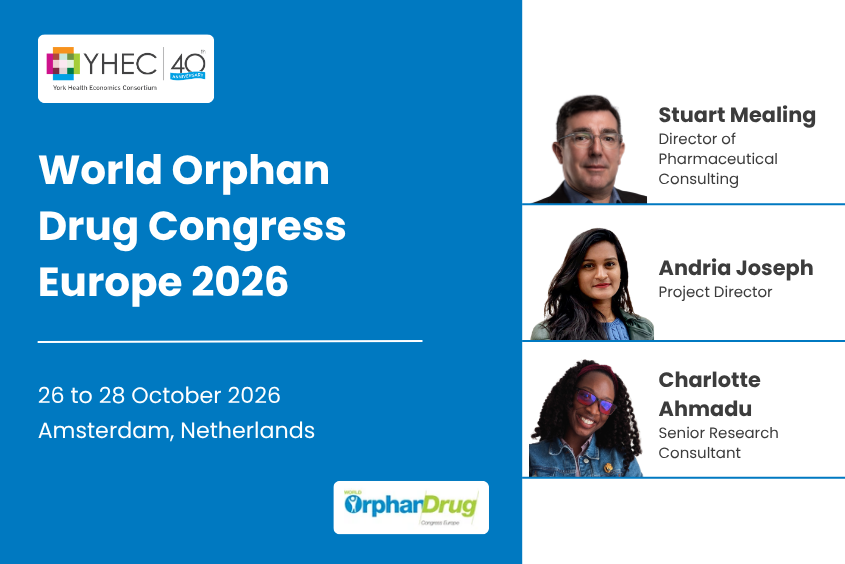
YHEC is excited to join industry peers, patient advocacy groups, and global rare disease leaders at WODC Europe 2026 in Amsterdam. Three staff members are representing YHEC at WODC this year, including our Director of Pharmaceutical Consulting and Project Director in the patient-reported outcomes service. If you would like to arrange a meeting with our team at WODC, please contact us.
Working group
We are delighted to be leading an interactive working group at this year’s event! The team will be hosting a roundtable discussion on defining minimum evidence standards for demographic diversity in rare diseases. Find out more information below:
Who Makes the cut? Defining a minimum evidence standard for demographic diversity
- Date: Tuesday 27 October
- Time: 11:30 AM to 12:30 PM
- YHEC leads: Stuart Mealing, Andria Joseph and Charlotte Ahmadu
Working group details
Evidence generation in rare diseases presents a fundamental challenge for decision-makers. Small and heterogeneous patient populations, limited trial recruitment, fragmented data sources and reliance on registries or natural history studies can make it difficult to determine whether available evidence adequately reflects the population who will ultimately receive an intervention. At the same time, expectations around demographic diversity, equity and patient involvement are increasing across regulatory, HTA and healthcare decision-making.
However, there is currently limited agreement on what information is minimally necessary to judge whether rare-disease evidence is sufficiently representative, transferable and meaningful. Conventional expectations developed for larger populations may not always be appropriate or feasible in rare diseases, where subgroup analyses may be statistically impossible and excessive data requirements may introduce additional privacy, ethical and participation burdens.
Roundtable objective
This exploratory roundtable will bring together patients and patient organisations, clinicians, regulators, HTA and payer representatives, researchers, registries and industry to consider:
What is the minimum demographic, equity-relevant and patient-experience information required to determine whether evidence from a rare-disease study is applicable to the patients who will receive the intervention?
Rather than treating diversity as an end in itself or defining representativeness solely through demographic percentages, the discussion will focus on whether decision-makers can understand who generated the evidence, who may be missing, which sources of heterogeneity are clinically or socially important, whether outcomes may differ across relevant groups, and how these uncertainties should influence interpretation and decision-making.
Participants will be invited to consider the question from their own perspective: what information does a regulator require to assess benefit-risk, what does an HTA body or payer require to determine value and transferability, what does a clinician require to apply evidence to an individual patient, what information matters to patients and carers; and what can sponsors, registries and researchers realistically collect?
To find out more about the working group, contact us. For information about attending, please visit the WODC Europe 2026 website.