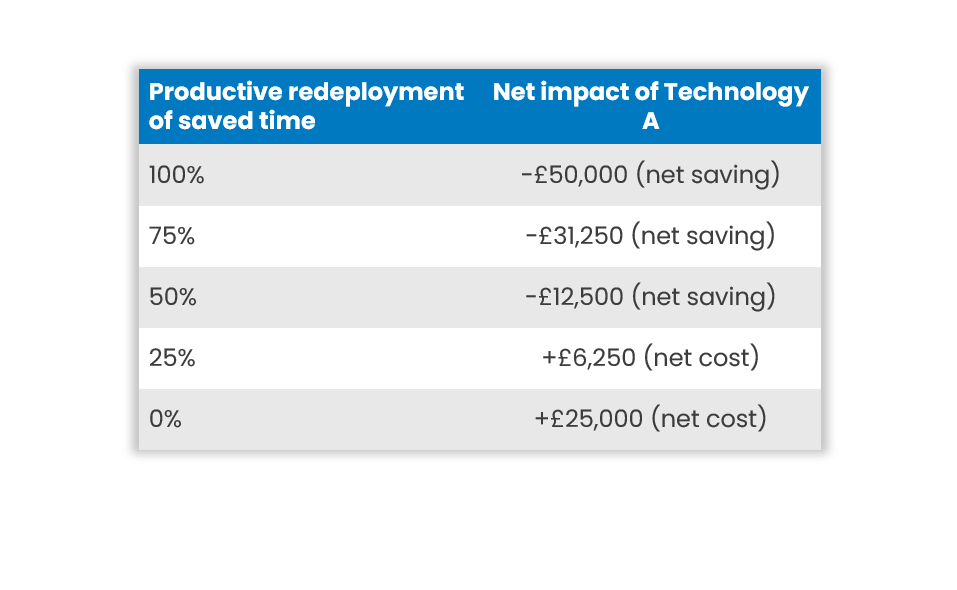
In this example, the technology only remains cost saving if approximately one-third or more of the released time can be effectively redeployed. Below that threshold, the intervention shifts from generating savings to creating additional costs.
This example is only an illustration, and it is important to note that the relationship between redeployment of time and cost savings is unlikely to be linear or even monotonic. For example, it is possible that staff operating at 90% capacity could be more productive than those operating at 100% capacity.
This illustrates an important point: the relationship between time savings and cost savings is complex and the value of time savings depends not only on how much time is released, but also on whether that time can realistically be used in a meaningful way.
Not all time savings are equally useful
The scale and distribution of time savings matter just as much as the total number of hours saved.
Many digital technologies report modest time savings spread across large numbers of staff. Saving two minutes per nurse each day may sound impressive when aggregated across an organisation, but two isolated minutes are unlikely to allow a clinician to see another patient, complete a meaningful task or fundamentally change the way they work. However, even just 2 minutes of released time may have a meaningful impact on a person’s wellbeing and so this may still offer value.
By contrast, consolidating those same savings so that fewer clinicians gain an uninterrupted hour each day creates genuinely usable capacity. That hour can be spent seeing additional patients, completing complex documentation, supervising colleagues or undertaking quality improvement work.
In other words, a thousand small fragments of time are not necessarily equivalent to one continuous block of time. Yet conventional economic evaluations often treat them as though they are.
When discussing productivity within the NHS, it is common to see productivity equated to increased activity. It is easier to relate continuous blocks of time to increased throughput; for example, one hour saved per clinician could allow for one extra clinic to be provided. When time savings are fragmented, this argument becomes more challenging. However, just because the value of fragmented time savings on staff wellbeing cannot easily be quantified or monetised does not mean that those savings are necessarily less valuable.
How clinicians say they would use released time
Research from The Health Foundation highlights another important consideration: the value of released time depends on what clinicians are actually able to do with it. When clinicians are given just one additional hour, the most common priorities are direct patient care (27%), reducing overtime (17%), quality improvement (13%), administrative catch-up (10%), professional development (9%), taking a break (7%), training (7%) and research (4%).
Interestingly, the picture changes as more time becomes available. With three hours of released time, clinicians increasingly prioritise activities that are often difficult to fit into busy clinical schedules. Nearly half report they would focus on quality and service improvement (48%), while 46% would dedicate more time to direct patient care. Education and training also become more prominent, alongside continued reductions in overtime and time for administrative work.
These findings suggest that released time is not simply converted into more appointments. Instead, it supports a broader range of activities that strengthen healthcare delivery over the longer term.
Broadening the way we think about value
This raises a broader question for health technology assessment. Current evaluations often focus on whether a technology produces immediate financial savings. However, released clinical time frequently generates benefits that are valuable without appearing as cash savings on a balance sheet. For example, reducing overtime may improve staff retention, allowing clinicians to take appropriate breaks can reduce fatigue and cognitive burden, and creating time for quality improvement projects or training may improve patient outcomes long after the initial investment has been made.
These benefits are real, even if they are difficult to express as direct reductions in expenditure.
A more realistic approach to evaluating time-saving health technologies
As digital technologies become increasingly central to healthcare delivery, our methods for evaluating them also need to evolve.
Rather than relying on a single estimate of cost savings, evaluations should acknowledge that released time often creates capacity rather than saving money. They should:
- Identify the level of productive redeployment required for a technology to become cost effective.
- Consider whether the pattern of released time is practically usable and estimate how many additional patients can realistically be treated/seen.
- Capture broader outcomes such as workflow improvements, staff wellbeing, reduced burnout and opportunities for service improvement, alongside traditional productivity measures.
Ultimately, time is one of healthcare’s most valuable resources, but its value cannot be captured by a simple multiplication of hours by salary costs. Understanding how time is released, how it is used, and who benefits from it is essential if we want to make informed decisions about investing in health technologies.
Moving beyond oversimplified assumptions will lead to more realistic economic evaluations and, ultimately, better decisions for both healthcare professionals and the patients they care for.
Want to learn more?
Visit our website to find out more about our work across the healthcare sector and reach out to discuss how we can support your health economic evaluation needs.