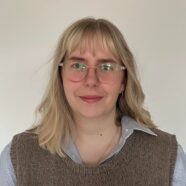
Interested to find out more about what it’s like to work at YHEC? Or maybe you have an interest in healthcare systems and the public sector and are wondering what a career in this area is like? In this blog we interview Barbara Uzdzinska, a Senior Research Consultant at YHEC. We find out how she got into this role, what her day-to-day work looks like, and what she enjoys most about being part of YHEC.
What is your name, role and workstream?
My name is Barbara Uzdzinska, and I’m a Senior Research Consultant specialising in NHS consulting at YHEC.
Tell us about your qualifications and career path up until this point
I did an undergraduate degree in Economics at Lancaster University and graduated in 2019. As part of my degree, I completed a health economics module that I found really interesting. Although I was also drawn towards behavioural economics, I feel that the impacts of health economics are more tangible.
After graduating, I worked in the NHS bowel cancer screening service. I started in March 2020 and because of COVID-19, screening was paused and my training got put on hold. Consequently, I was redeployed to various areas of the hospital: I worked in outpatient clinics, diabetes, immunology, a COVID-19 ward, and the equipment library. I got great insights into how different departments in the NHS work.
After a few years at the screening service, I did a Master’s in Health Economics at the University of York. As part of my course, I completed my dissertation at YHEC, working on a project about the environmental aspects of using nitrous oxide in labour. At that point, I’d already applied for and been offered a job at YHEC!
Tell us more about your role and where it sits within YHEC
I’m involved in a wide range of NHS consulting projects here at YHEC, and I work closely with colleagues across the company. My day-to-day activities vary: I might be conceptualising how we’re going to develop a model, spending time building models, undertaking the necessary analysis, or liaising with clients or our evaluation partners.
We work with a variety of organisations, in both the private and public sectors, in the UK and internationally. In the private sector, one of the key things we do is use our in-depth knowledge of the NHS to help develop robust business cases. The NHS is a unique and complex system, and we help companies to successfully navigate that. Of course, we also work directly with the public sector, including the NHS itself – the trusts, hospitals, GPs, and the integrated care boards and systems. Since these different parts of the NHS have a degree of freedom in the devices or tests they choose to use, we often create models that can be localised to particular trusts. We might be supporting specific hospital departments with an innovation they are aiming to roll out more widely or working with health innovation networks to evaluate new policies. We also undertake work for government departments, like the Department for Work and Pensions and the Department for Health and Social Care, as well as various charities and similar organisations.
Tell us more about the impact of your work
As I mentioned previously, the NHS is a unique system, there’s really nothing else like it: it’s different from social insurance or the US private systems. We have a deep understanding of the complexities of the NHS, from the national level down to local GP practices, and how all those parts interact. For instance, GPs are technically private, which can lead to complex interactions, especially for interventions that don’t easily fit into a current pathway or have the potential to be used in both hospital and community settings. Our expertise in the NHS is invaluable in helping to visualise exactly how a product or intervention could be used in terms of local and national pathways.
Our projects are incredibly varied, and we make sure that our work is robust by having a whole suite of approaches that we can use. We ask lots of questions, like considering how we can input information into a model to produce results that will be most useful for building a business case, figuring out how new interventions fit into current pathways, identifying complex areas, and highlighting aspects that need discussion with key stakeholders. I don’t think you can compare one model to another and see that it’s the same – it never is – and that’s the really fun part.
Finally, our work also helps clients get more funding, and this is especially true for public bodies and charities: for example, our published research can be crucial in supporting a case for more financial backing.
What do you love most about your role?
There are a few things that I love about my work. One is the variety in the work we do – which I know I’ve said a lot about already. There’s always something different going on, there are new methods and new concepts to explore, and new ways of doing things.
Another one is deep diving into quite a small aspect of the healthcare sector. A client might come to us with a specialised intervention for a specific disease or pathway, and we need to be sure that we’re not missing or overlooking anything that’s relevant, and that we have all the information we need. I just adore it!
I also enjoy the collaborative nature of the work. Often, our clients are the experts in their field, or they know people that they can put us in touch with. Sometimes, we’ve set up specialist advisory groups of clinicians or other relevant professionals like teachers. In some projects, we work with early data, or even no data; asking questions to make sure we have all the knowledge we need is crucial.
What are your favourite types of projects to work on, and why? Or perhaps you have favourite methods?
My favourite part of projects is the pathway modelling, working with the numbers and formulas. But in terms of the fields I love working in, it’s screening and public health projects. They are often quite messy, and there can be a lot of variation between, for example, local authorities or integrated care boards. The process of working out how to model a really complex aspect of the healthcare system can be tricky, but it’s wonderful to get there and very satisfying.
Going back to the bowel screening work that I did after my undergraduate degree, I still love screening projects, and my knowledge and experience mean that I can support colleagues who are working on other screening projects. I love being able to share that knowledge and recommend sources or explain local variations. A simple example of this is how bowel cancer screening works differently to breast cancer screening: bowel screening is completed on a national level using a home testing kit, whereas breast cancer screening requires local appointments, so it’s a more devolved service. I’m always keen to get involved and contribute to those kinds of projects: I’ve already talked about how I love learning, but I’m equally grateful for opportunities to share what I know. I really love shared learning, it’s fantastic, and it’s something that YHEC recognises and encourages too.
What do you enjoy most about working at YHEC?
It all goes back to learning and knowledge again. Colleagues at YHEC have such a wide and vast knowledge base that you’ll very rarely ask a question that no one can answer! Obviously, as a researcher, I love to try to find the answer myself first but it’s always valuable to get input from others too.
I love the variety of people’s backgrounds too: colleagues bring so much in terms of different experiences, and the breadth and depth of knowledge and experience that we have says a lot about YHEC as a company.
What areas of research are most interesting to you?
I think it’s quite well known that women’s health is really under researched; it’s featured in only a small proportion of the projects that I’ve worked on, so I would love to see more in that field. A lot of clinical research used to be focussed on men, so I would love there to be more research that I could get involved in.
Capacity modelling is another interesting field because you can either do something simple based on some assumptions around capacity, demand and supply, generating some quite broad results; or you can go really complex with queuing theory and patient-level models. There isn’t really a happy medium in the method, so it’s something that I would love to see developing in the future.
How do you see work in your field developing in the future?
Although I could see some methodological changes and more complex systems that we can model in a health economics evaluation, it’s hard to predict what will happen in the NHS, because it’s such a large organisation made up of so many parts: big changes can happen fast and sometimes frequently.
The NHS 10 Year Plan includes a focus on moving care from hospital settings to community and home settings, so I think we’ll continue working on things like virtual wards and hospital at home. YHEC has done considerable work in these areas already, we know a lot about it.
I also think that we could see more early intervention in common diseases like cardiovascular disease – things like lipid testing and blood pressure testing. There’s a movement towards prevention and early-stage treatment, rather than treating people once they’re actually unwell.
What’s your favourite thing to do outside of work?
I have a lot of hobbies! I’ve said this already, but I love learning and picking up a new skill, and the thing that I enjoy doing the most is making something physically. I’ve learned a lot this year because we recently bought a house, so I’ve been doing a lot of DIY and learning about prepping and painting walls, working with wood, staining, sanding, all of that.
My main two hobbies are probably knitting and sewing though. As well as finding them quite calming, I would love, one day, for my wardrobe to be mainly made from things that I’ve made with my own two hands.
Tell us a surprising or fun fact about you
I am a little bit tone deaf! There’s a spectrum and, with notes that are really close together, I couldn’t tell you whether one is higher or lower than the other, they will sound the same to me. I used to play the piano, but I found the listening aspect of the exams so difficult. Time signatures are something else that I just do not understand about music.
How can expertise in reviews and evidence synthesis help you?
Find out more about YHEC’s work with Healthcare Systems and the Public Sector or get in touch with us to find out how we can help with your project.