
Karina:
How much should we value benefits that occur today compared with those realised years, or even decades, into the future? This is a fundamental question in economic evaluation, particularly when decisions involve long-term outcomes such as improved health, disease prevention or increased life expectancy.
HM Treasury recently announced it will lower the baseline Green Book discount rate from 3.5% to 3.0%, marking the first reduction in the UK’s standard social discount rate in over 20 years. While discount rates might sound like a technical, back-room accounting detail, they play a massive role in how government decisions weigh present costs against long-term benefits. In healthcare, shifts in discounting can directly influence how we value long-term health outcomes, preventative public health programmes and high-cost therapies.
To unpick what this announcement means for health economics and HTA, I’ve brought together three YHEC colleagues: Stuart Mealing (Director of Pharmaceutical Consulting), Hayden Holmes (Director of Digital Health Technologies Consulting), and Professor Matthew Taylor (Chief Executive Officer). In this blog, you can read our conversation as we explore the underlying theory behind social discounting, how the Treasury’s update could impact NICE decision-making, and what these changes mean for the future of health appraisals.
What is the social discount rate and why does it matter?
Karina:
Before we dive into what this means for NICE and HTA, Mat, could you kick us off with the basics? What is the social discount rate and why do we discount future health and costs in the first place?
Mat:
It really comes down to human nature. People, and animals for that matter, generally prefer good experiences sooner rather than later. Kids count down the days to their birthday, and we all look forward to the weekend. On the flip side, when something’s unpleasant, we try to push it away. Who hasn’t delayed writing a report they didn’t want to write or put off going to the dentist, even knowing that waiting might make it worse?
There are exceptions, but overall, things happening sooner carry more weight in our sense of wellbeing. Some of that is psychological (“I want it now!”), and some is practical (“what if circumstances change before I actually get the benefit?”). To account for this, public policy applies a ‘discount rate’ to reduce the weight given to costs and benefits that occur further in the future.
Karina:
Hayden, from a health economics perspective, is discounting health outcomes conceptually the same as discounting money?
Hayden:
That’s actually where a lot of the debate lies. In most other policy areas, like transport, evaluations either look at undiscounted metrics or use financial proxies like the ‘value of a statistical life’, where both costs and benefits are measured in pounds. People clearly prefer money today over money in ten years, so discounting cash flows makes complete sense.
Health is different. You can’t trade, save, or bank health like money. Asking someone, “Would you rather have £100 now or in five years?” is easy to answer. But “Would you rather have 5 QALYs now or in five years?” doesn’t really translate. If you reframe it as a choice between health profiles, for example “Would you rather have 0.8 QALYs per year for 10 years, or 1 QALY per year for 5 years followed by 0.3 QALYs for 5 years?”, people do start trading off their health over time.
In fact, many people would happily accept a bit less health today if it meant being healthier later in life, especially since health is capped on a zero-to-one scale at any given moment. We don’t view lifetime wealth on a fixed scale like that, but we do view our physical health that way.
Karina:
Stuart, coming at this as someone who looks at how these decisions play out in practice on the NICE rare disease committee rather than as a pure theoretical economist, does that distinction resonate with what you see?
Stuart:
Completely. Outside of pure economics circles, discounting is often treated as a bit of a dry mathematical constant in a spreadsheet. But when you sit in committee meetings, you realise it underpins every single trade-off we make. It determines whether a benefit delivered 20 years from now gets proper weight or gets practically written off on paper.
Why would the rate change and what has changed now?
Karina:
That distinction around time preference brings us to the Treasury’s announcement. Why do discount rates get revised theoretically, and what is the new Green Book guidance setting out?
Mat:
The discount rate isn’t set in stone. It’s calculated using several underlying factors, including pure time preference, expected consumption growth, and the diminishing marginal utility of consumption. As economic conditions shift over time, holding onto an old rate gets harder to justify.
The standard Green Book discount rate of 3.5% per year (for the first 30 years) had been in place since 2003. Following the review by economists at the Universities of Exeter and York, the Treasury accepted the recommendation to lower the baseline discount rate to 3.0%, with a commitment to review it every five years. The main goal here is to give greater weight to long-term future benefits when evaluating public investments.
Karina:
Hayden, how does this static 3.0% Treasury rate compare to what’s happening in financial markets right now?
Hayden:
It’s an interesting contrast. The 5-year government bond yield is currently hovering around 5%. In many other countries, bond rates are used to justify discount rates because market yields implicitly factor in economic risk, which is something fixed discount rates don’t explicitly model out into the future.
What’s still unclear is the underlying foundation NICE uses for its rate. Is it driven purely by societal time preference, or does it reflect the opportunity cost of capital expenditure within the NHS budget, or is it a bit of both? NICE hasn’t made it explicit whether its choices are driven by internal forecasting, academic research, or simply following Treasury directives.
Stuart:
And that ambiguity is exactly why every Treasury update causes a bit of a stir in HTA. Historically, whenever the Green Book moves, the health sector starts watching closely to see if NICE will simply mirror the Treasury’s macro-economic logic or take a step back and look at whether NHS opportunity costs require a different approach.
What does this mean for NICE and HTA in practice?
Karina:
Stuart, you’ve spent years working in HTA and sitting on NICE committees. Looking back, how has NICE handled Treasury discount rate changes historically, and what do you expect to happen now?
Stuart:
Going back to when I started out in HEOR, we actually used differential discount rates in health economics, discounting costs and health benefits at different rates. My boss back then told me it was tied directly to the Treasury Green Book. When Treasury moved to a single 3.5% rate, NICE followed suit. Because of that history, my bet is that NICE will probably just switch to 3.0% before too long.
What worries me a bit is how this plays out in practice for industry submissions. Industry seems fairly optimistic right now, especially with discussions around the cost-effectiveness threshold and talk of incorporating productivity into HTA. But under Recommendation 4 of the Green Book review, the reduced rate for health outcomes, which allowed a 1.5% discount rate in specific cases, is being brought in line with the standard 3.0% rate.
I’ve seen a real increase in companies trying to leverage that 1.5% special case in submissions. It’s a tricky issue, and we’ve spent many hours debating the nuances of it in NICE committee meetings! That 1.5% rate has typically only been granted for ‘one-and-done’ interventions like gene therapies, where costs happen upfront in the first few months but benefits stretch out across decades. Using 1.5% brings the ICER right down and helps justify a higher price. The Association of the British Pharmaceutical Industry (ABPI) has been lobbying for a permanent drop to 1.5% across both costs and benefits, but I really hope we don’t go down that road.
Mat:
What makes you say that, Stuart?
Stuart:
Well, for most technologies, the increase in discounted benefits under a lower rate will far outweigh any change in costs. That naturally drives ICERs down, which sounds positive, but in reality, it leaves room for higher pricing without necessarily delivering extra net value to the NHS. The fact that industry is pushing so hard for lower rates tells me they’re expecting the same thing.
Mat:
That’s fair, but looking at it from the health system side, I think there’s already too much short-term thinking in the NHS. Local decision makers rarely look beyond a two-to-three-year horizon. Lowering the discount rate encourages a longer-term view for prevention and chronic conditions, which I’m all for. I wouldn’t drop it to zero because of future uncertainty, but I don’t think we should penalise long-term health gains through time preference.
Hayden:
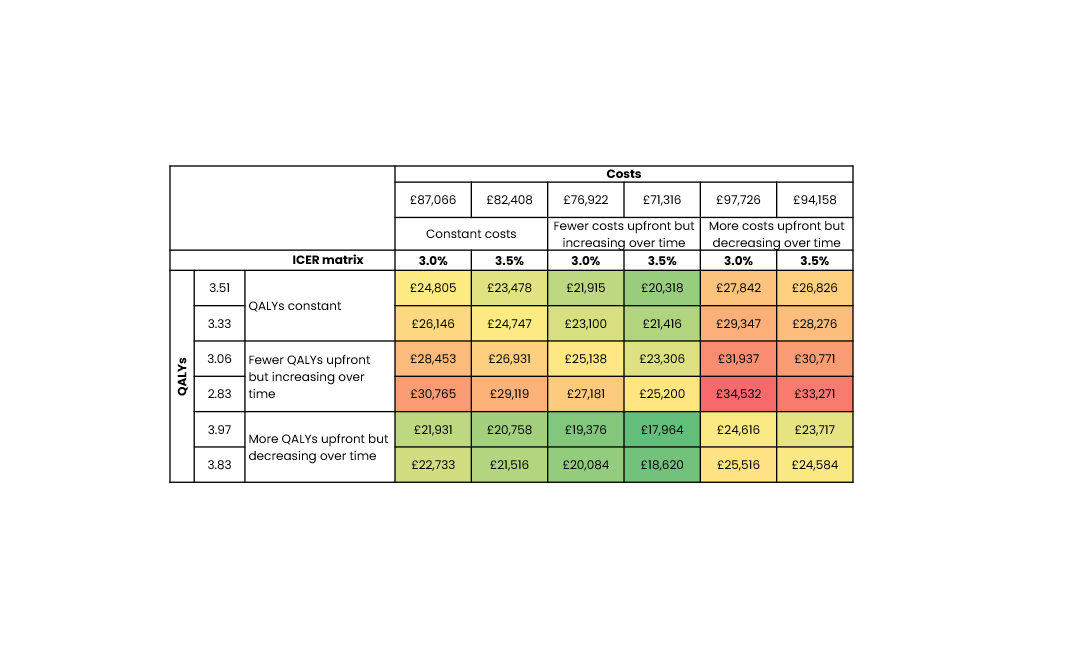
To see how these numbers play out in practice, I put together a matrix comparing different cost and benefit profiles over a 25-year window, looking at how the ICER shifts when applying 3.0% versus 3.5% discount rates. In this example, every scenario starts with the exact same un-discounted totals: £125,000 in costs and 5 total QALYs gained. The only thing we vary is timing.
Hayden:
As you can see, the timing of when costs and gains occur creates a huge difference in the ICER, almost doubling the cost per QALY from £18k to £35k under the 3.5% rate, even though the total un-discounted health gains and spend are identical!
Lowering the discount rate from 3.5% to 3.0% reduces the ICER across every single scenario, but it has the largest absolute impact on interventions with front-loaded costs and delayed benefits (dropping the ICER by over £2,500 per QALY gained). This gives a clear boost to technologies whose long-term health gains previously got discounted away over time.
That said, Recommendation 4 raising the health discount rate to 3.0% rather than keeping a 1.5% option feels a bit out of sync with the NHS 10-Year Plan’s focus on prevention. By discounting future health at 3.0% instead of 1.5%, we end up discounting away more of the long-term gains that public health programs create.
Karina:
Isn’t there also a bit of a mathematical trap if health and costs are discounted at different rates?
Hayden:
Definitely. If health outcomes are discounted at a lower rate than costs, you get this weird paradox where an intervention will almost always look more cost effective if you simply delay starting it by a few years. Future costs drop off faster than the health benefits in the denominator, which creates an absurd incentive to keep putting off healthcare programs. However, there are other considerations at play too. I think we have often accepted the discounting of both costs and benefits at the same fixed rate because of accounting principles rather than health economic strategy. When costs and benefits happen at the same time, discounting is less likely to have an impact on the results. This represents most of our pharmaceutical spend.
Think of it simply: if we take a medicine now, we feel better now. So, paying for drugs now, generally leads to benefits now. This is not the case for chronic, long-term or life-long illnesses, vaccination programmes or other preventative public health initiatives. To me, differential discounting deserves a much more open debate. Even if it introduces some tricky incentives around delaying spending, we can manage and discuss those trade-offs openly once we’re aware of them. This is a far better approach than simply ruling it out altogether.
What could social discounting look like in the future?
Karina:
That opens up broader questions about how we value the future more generally. Mat, I know you’ve looked into what happens when standard discounting models are applied to long-term risks outside of health. How does that fit into this?
Mat:
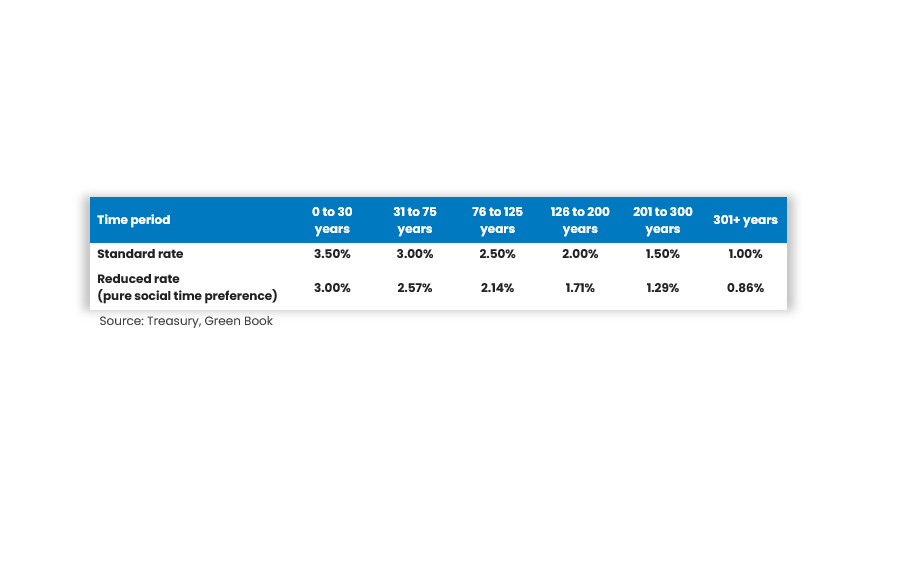
It really highlights how standard discounting breaks down over very long timeframes. If you look at the Treasury Green Book’s step-down scale for long-term appraisals:
Mat:
When you calculate the present value of future events over long horizons, the numbers drop off exponentially:
- 10 years out: Retains 73.4% of its value (at 3.5%)
- 50 years out: Retains 20.4%
- 100 years out: Retains 5.3%
- 150 years out: Retains 1.7%
- 500 years out: Retains just 0.02% (1/1500th) of its original value!
To take an extreme example, imagine a policy that could definitely prevent human extinction 500 years from now. If you value 8 billion people losing 30 QALYs each at £70,000 per QALY, the undiscounted value is roughly £16.8 quadrillion. But once discounted, that present value shrinks to £11.1 trillion, about 15% of current global GDP. Under standard economic logic, if that policy cost £15 trillion today, you’d reject it.
It’s an extreme thought experiment, but it shows how standard discounting can severely undervalue catastrophic future risks. For environmental policy, there’s a strong argument for not discounting at all to protect future generations.
Hayden:
Treasury guidance actually says long-term environmental risks should be handled through natural capital frameworks rather than discount rates. But in health economics, we don’t have a separate setup like that inside HTA models. If you tried mixing a 0% environmental discount rate with a 3.5% health rate in NICE submissions, you’d get strange situations where a QALY saved from a heatwave is valued completely differently from a QALY saved by a medicine at the exact same point in time.
Final reflections
Karina:
To wrap up, as NICE considers its response to the Treasury’s 3.0% rate, what are your main takeaways?
Mat:
Moving from 3.5% to 3.0% is a welcome step toward encouraging longer-term thinking, though I doubt a 0.5% drop on its own will dramatically alter decisions.
In theory, if NICE lowers its rate and more interventions pass the cost-effectiveness threshold, the opportunity cost across the NHS goes up. Mathematically, that should mean the cost-effectiveness threshold itself ought to come down, because displaced services would yield higher QALY gains per pound spent. I don’t expect NICE to lower the threshold in reality, but we have to remember that in a fixed budget, favouring long-delayed gains means something else misses out, often treatments providing immediate help to patients with shorter life expectancies.
Stuart:
I just hope NICE doesn’t quietly adopt 3.0% without any discussion. It would be great to see an open conversation about what discounting in HTA is actually aiming to do: whether it’s about societal time preference, NHS opportunity cost or broader government policy.
Karina:
Absolutely. It’s clear that while a 0.5% reduction sounds like a small technical adjustment on the surface, it opens up big questions around fairness, budget trade-offs and how we value health over time. Thanks all for a great discussion!
Contact us
If you need support with economic evaluation or navigating complex policy and appraisal frameworks, contact us today to learn more about our health economic evaluation services and how our expert team can support your organisation.